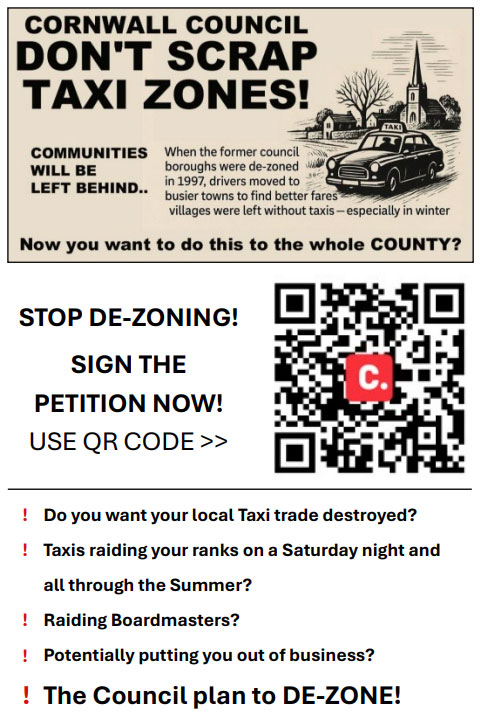
DE-ZONING THROUGH THE BACK DOOR?

❗Is Cornwall Council quietly dismantling our taxi system — without saying so?

Cornwall Council is pursuing a unified Hackney Carriage tariff across all six zones. They say it’s just about fares — but the truth is:

  • Tariff harmonisation only makes sense if zoning is going to be scrapped.
  • But they have yet to declare that is their intention, and there’s been NO open discussion. NO proper consultation. NO honesty.

⚠️ IS THIS IS DE-ZONING THROUGH THE BACK DOOR?

They’re not saying it outright — but by changing fares now, they’re removing the foundation of the zoned system without a vote, without input, and without consent.

Is this reform – or is it restructuring by stealth?

❌ WHAT HAPPENS IF DE-ZONING GOES AHEAD?

  • Drivers flood into our town, chasing high-demand jobs – stealing your work – especially at night.
  • Rural areas are further abandoned — no drivers, no coverage.
  • Your Earnings cut in half? — taken by opportunists from other areas.
  • No Rank Space — Already swamped Ranks, further swamped by operators who have dropped in for the evening.
  • You think it’s bad now?

Any operator who drops people in the town, can now lawfully stay and work until the return pickup time – taking your work!

URGENT! – CLICK HERE NOW

🛑 THIS IS A WARNING TO THE TRADE IN NEWQUAY

Do we want Cornwall Council to:

  • Change tariffs without a public conversation about zoning.
  • Pretend this isn’t part of a bigger agenda.
  • Push policy quietly through the back door.

📣 ASK YOURSELF — AND EACH OTHER:

Do YOU want the de-zoning of Cornwall’s taxi system? How will that affect your business? Should the Council be allowed to dismantle zones without a formal consultation?

URGENT! – CLICK HERE NOW

Taxis in Cornwall, are you breaking the Law?

The Broken Shape of the Local Taxi service in Cornwall.

Cornwall council, have a duty of care to their constituents, and by default that includes ensuring a viable, well run local taxi service that can provide vital services for all, regardless of location. Not one that is constantly having to break the law.

The solution is simple, it has been provided to them. It is within their power and discretion to implement this solution, they just have to do it, but read more…

The solution – Booking Fee

The solution to this problem arrives back at amending the Table of Fares under the ‘Extras’ section, to implement a Callout/Booking Fee structure that can be lawfully charged when a Hackney Carriage must travel excessive distance (more than 1 mile) to pick up the hirer/passenger within its district, in order to ensure a viable service which can be available to all users no matter how rural their location may be. This has already been done in the borough of Telford & Wrekin, (see their Table of Fares here) and can be justified as follows:


The ability of Telford & Wrekin Council to implement such a booking fee can be understood within the framework of local authority powers under the Local Government (Miscellaneous Provisions) Act 1976, specifically within the latitude given by Section 65 to set fare structures for hackney carriages. Here’s how they might have legally implemented this:


Key Points of the Legislation


  1. Section 65:
  • Local Authority Power to Set Fares: This section allows local authorities to fix the rates or fares for the hire of hackney carriages within their districts, and it encompasses setting maximum fares for journeys within the district.
  • Structure and Extras: The fare structure can include not just the fare for the journey itself but also any additional charges (extras) that the local authority considers reasonable.


Legal Implementation of the Booking Fee


  1. Extras and Fare Tables:
  • The council has the authority to define what constitutes an “extra” in the fare table. This means they can include additional charges for specific conditions or circumstances, such as a booking fee for pre-booked journeys.


  1. Consultation and Approval:
  • Public Notice and Consultation: When local authorities want to set or change fares, including extras, they typically must follow a process that includes publishing the proposed fares, allowing for public consultation, and considering any objections.
  • Council Decision: Following the consultation, the local authority’s decision to implement the changes must be formalized through a council meeting where the changes are approved and adopted.


  1. Reasonableness and Justification:
  • Reasonableness: The charge must be reasonable. By setting a cap on the booking fee (e.g., £36 Tariff 1, £45.60 T2 & £60 T3 – (=12 miles)) and defining the calculation method (e.g., £3.00 T1, £3.80 T2 & £5 T3 per mile from a one-mile radius of vehicle base address – charged per 1/10th mile), the council can justify that the fee is a reasonable and predictable extra.
  • Justification: The council may justify the booking fee based on factors like the cost and time involved in reaching the pick-up point, particularly in a spread-out area such as Cornwall where drivers may incur significant travel time and expense to fulfil bookings.


Compliance with Section 67

While Section 67 of the Act generally prohibits charging more than the metered fare for journeys wholly within the district, it does allow for extras if they are part of the authorized fare structure. If the booking fee is included in the fare table adopted under Section 65, and the metered fare plus any legitimate extras do not exceed what is permitted, then it complies with the law.


Summary

Telford & Wrekin Council has followed the legal process to amend the fare structure under Section 65 of the Local Government (Miscellaneous Provisions) Act 1976 (see their Table of Fares here). By defining a booking fee as an extra charge in their published fare table, and ensuring it is applied reasonably and within a clear framework, they have legally included this fee in their fare system. This aligns with the council’s authority to regulate fares and extras within their district, as long as the process for setting and amending these fares complies with statutory requirements, including public consultation and formal adoption by the council. There is no reason why Cornwall Council cannot do the same.


Proposed Table of Fare Amendments to solve the problem (Restormel Zone):


Questions & Answers:

So why have we set our maximum Booking Fees higher than Telford & Wrekin?

 Restormel Zone is geographically a much larger and more rural area than Telford & Wrekin, with 61% less population per square mile, meaning that drivers will have to travel more extreme distances to pick up passengers than in the Telford & Wrekin area, making for an even stronger argument for implementing this charge. We need to look at the following two questions:


How big is the Borough of Telford & Wrekin?

The borough of Telford and Wrekin in Shropshire, England, covers an area of approximately 112 square miles (290 square kilometres). As of the most recent data, the population of the borough of Telford and Wrekin is approximately 191,000 persons. That’s 1,705 persons per square mile.


How big is the Restormel Zone (former Borough of Restormel)?

 The former borough of Restormel in Cornwall, England, covers an area of approximately 172 square miles (445 square kilometres) before it was abolished in 2009 and merged into the unitary authority of Cornwall. Population figures from 2011 state a population of 103,600 persons. From 2011 to 2021, the population grew by 7.1% in Cornwall, so let us estimate a current population of 113,162 (7.1% / 10 yrs. * 13 yrs. = 9.23%). So, the area of Restormel Zone is 54% larger with 40% less population than the Borough of Telford & Wrekin, resulting in Hackney Carriage drivers having to cover much larger distances to pick up the hirer on pre-booked journeys. That equates to 658 persons per square mile, which means 61% less population per square mile than the borough of Telford & Wrekin.


Why is the booking fee rate set to £3 per mile?

Well, we need to establish the cost of travelling to the pickup point for the driver/operator of the hackney carriage, based on fuel cost, all other expenditure, time, and of course there must always be a profit element in all business to make it a viable option. The great thing about this is that we have already established what that rate per mile is, as reflected in the charge per mile currently in the Table of Fares. So why would it be any different? Plus, in the interests of fairness, the passenger is not charged for any distance travelled that falls within a 1 mile radii of the vehicles base operating address.


Can this be done on the meter?

Yes it can. Certainly on Digitax meters, the ‘K2’ button can be employed to apply this extra to the total fare and programmed with the maximum charge, and by charging this extra ‘per 1/10 mile’ achieves total accuracy of the booking fee charge (the maximum charge must be a direct multiple of the mileage rate in this case 12 miles). The great benefit of this is that on a pre-booked journey, you can show the total fare due from the hirer including the booking fee and any other extras.


Why a 1 mile radii for excess mileage and not further?

Each mile has a significant cost to the driver/operator, and this cannot be ignored, currently estimated at 53 pence per mile (this is only immediate cost and does not include fixed overheads to the business). Before 1997, Restormel was divided into 3 zones – Newquay, St Austell and the villages in between, so under this legislation, once you left the boundary of Newquay, you were out of your district, so you could then pre-agree fares, so this problem did not exist. The whole country was laid out this way, but local authorities have continually centralised and merged areas, but the legislation has not changed to help the trade adapt.


Why 12 miles for the maximum booking fee?

A fair and reasonable way to decide this is to look at some common ‘excessive’ mileage pickup locations within our district of Restormel such as Roche (12.7m), St Dennis (10.1m), Nanpean (11.6m), Seaview Terrace in Summercourt (9.5m), St Columb (6.8m) or Talskiddy (9.1m). The list could go on, but a maximum of 12 miles would seem a justifiable limit for the maximum booking fee that can be charged, but of course for lesser distances the fee would always be relative to the distance travelled. Setting the maximum on this basis supports the trade in ensuring a viable service can be operated, protects the hirer by being inline with consumer protection principles, and helps to ensure services are available for all residents regardless of rural location reducing the risk of crime such as drink driving.


Three examples of Journeys with a Booking Fee:


  1. Red Lion, Fore St, St Columb to Indian Queens

Pickup to Destination: 3.2 miles

Metered Fare £ 12.30

Distance to pickup (from 123 Taxis Office): 6.8 miles

Booking Fee (6.8 less first mile = 5.8 x £3) £ 17.40

Total Fare inc. Extras £ 29.70 (Maximum fare that can be charged)

Current Advanced Booking Price (123 Taxis) £28.00


  1. Bowgie Inn to Cubert

Pickup to Destination: 2.7 miles

Metered Fare £ 10.80

Distance to pickup (from 123 Taxis Office): 5.0 miles

Booking Fee (5.0 less first mile = 4.0 x £3) £ 12.00

Total Fare inc. Extras £ 22.80 (Maximum fare that can be charged)

Current Advanced Booking Price (123 Taxis) £18.00


  1. Quintrell Inn to Mitchell

Pickup to Destination: 4.3 miles

Metered Fare £ 15.60

Distance to pickup (from 123 Taxis Office): 2.7 miles

Booking Fee (2.7 less first mile = 1.7 x £3) £ 5.10

Total Fare inc. Extras £ 20.70 (Maximum fare that can be charged)

Current Advanced Booking Price (123 Taxis) £19.00